If you've ever stood in front of a wall of leafy greens growing without a speck of soil and wondered "how on earth does that work?" - you're in the right place. Aquaponics and hydroponics both grow plants without soil, and people often use the words interchangeably. They're related, but they are not the same thing. This guide explains the difference in plain English, weighs the pros and cons, and helps you decide which fits your space - drawing on what we've learned running a working aquaponics farm in the heart of Singapore.
The one-sentence version
Hydroponics grows plants in water dosed with man-made liquid nutrients. Aquaponics grows plants in water that is fertilised naturally by fish, so there is far less to dose by hand. Aquaponics is, in a sense, hydroponics with a living engine bolted on. Everything else - the differences in cost, effort, taste and sustainability - flows from that one distinction.
How hydroponics works
In a hydroponic system, plant roots sit in water (or a soil-free medium like clay pebbles, known as LECA) instead of soil. Because there's no soil to supply nutrients, you add them yourself: a precisely mixed liquid fertiliser containing nitrogen, potassium, phosphorus and trace minerals. The water is usually recirculated past the roots, sometimes as a thin film (the "nutrient film technique," or NFT), sometimes by simply letting the roots dangle into a reservoir.
It's clean, fast and space-efficient - which is exactly why it suits cities. The trade-off is that you are the life-support system. You mix the nutrients, monitor the strength with a meter, top up the water and replace the solution periodically. Get the dose wrong and the plants feel it quickly. It's a wonderfully controllable way to grow - and that control is both its strength and its homework.
How aquaponics works
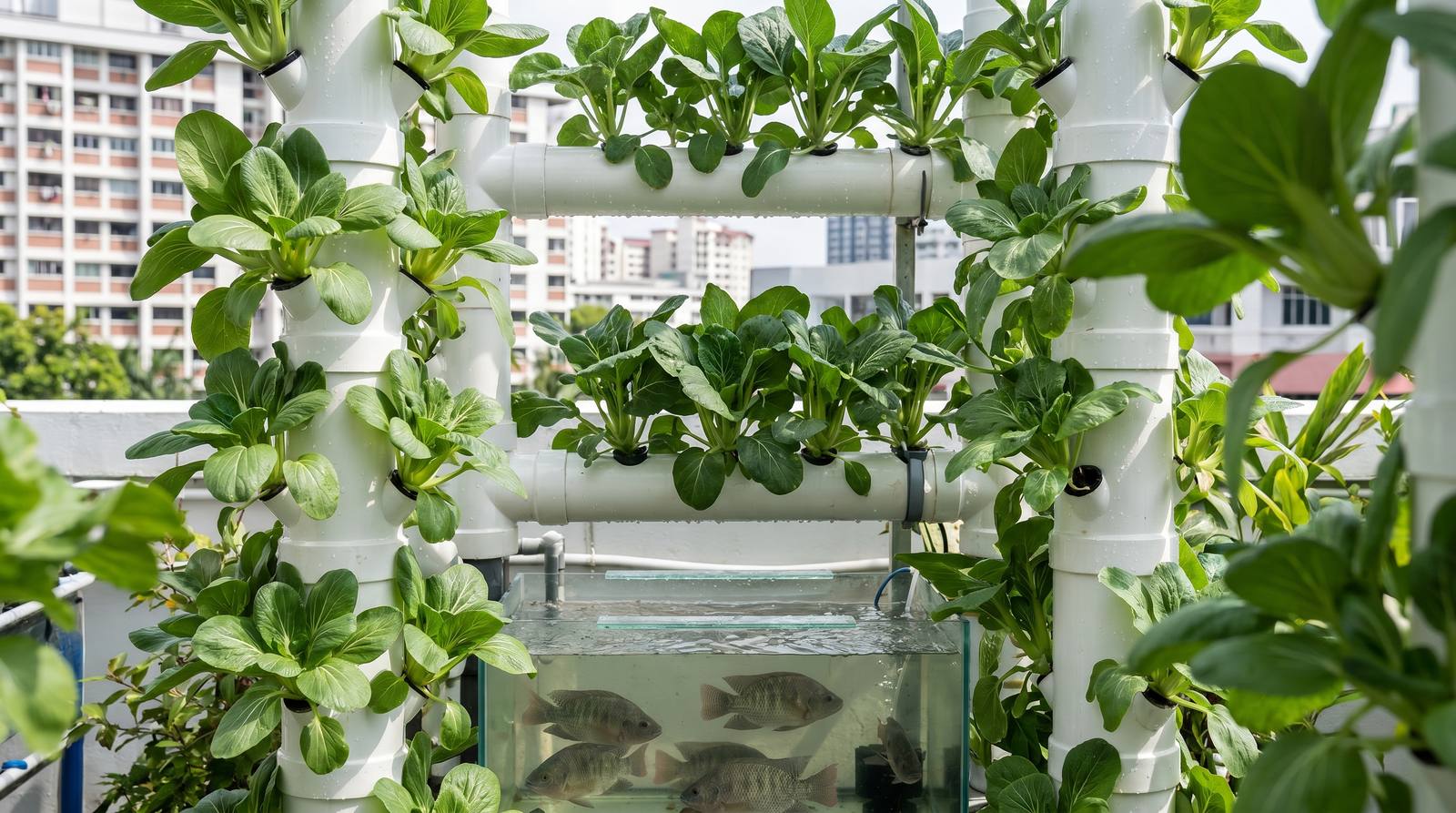
Aquaponics adds fish to the picture and lets nature do the fertilising. It runs on a simple, beautiful loop:
- Fish produce waste (ammonia) as they eat and grow.
- Beneficial bacteria - and, in our systems, compost worms - convert that waste into nitrates, the same nutrients plants crave. This is the natural "nitrogen cycle" at work.
- Plants absorb those nutrients and, in doing so, filter and clean the water.
- The clean water flows back to the fish, and the cycle repeats - endlessly, as long as the fish are fed.
Very little is wasted, and there is far less to buy, mix or dispose of. Once a system is "cycled" and balanced, it largely runs itself. This natural loop is the heart of every system at our farm, and it's the part visitors - especially children - find hardest to look away from.
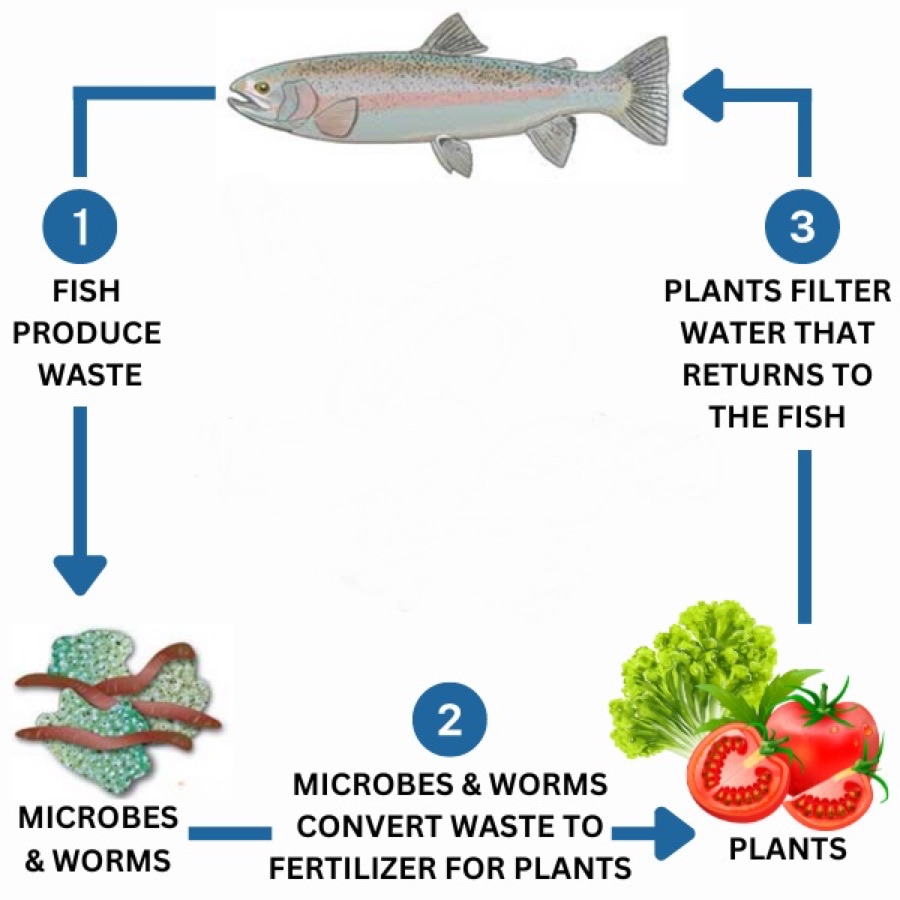
Think of it this way: in hydroponics you feed the plants. In aquaponics you feed the fish, and the fish feed the plants.
Why two doctors chose aquaponics
Two Doctors Aquaponics didn't start as a business - it started as one doctor's fascination. Back in 2015, Dr. Lim Jia Yang, a practising GP, became captivated by a simple idea: that you could grow vegetables using nothing but fish waste. To him it wasn't just a clever trick; it was a sustainable way to produce food, using a fraction of the water and land of traditional farming. He built his first system at home and kept refining it.
That backyard experiment grew. In 2019 he was awarded the OCBC Environment Care Fund to build a micro-farm at the Medical Alumni Complex, and along the way he helped many friends set up their own systems. Joined by Dr. Wang Fei Fan - an ENT specialist who believes wellness extends beyond the physical to include mental well-being - the two doctors turned a shared belief into a farm: that growing your own food, even a little of it, grows healthier, calmer, more connected lives.
We mention this not to boast, but because it shapes how we answer the aquaponics-versus-hydroponics question. We're not loyal to one method for its own sake - we run and teach both. We simply found that the closed, self-recirculating loop of aquaponics fit our mission best. Which one fits you depends on your goals.
Pros and cons at a glance
Hydroponics - strengths
- Simpler to start; no livestock to care for
- Very fast growth with precise nutrient control
- Compact, tidy and predictable - great for small spaces and beginners
Hydroponics - watch-outs
- Ongoing cost of nutrient solution
- You must monitor and dose accurately, or plants suffer fast
- Spent nutrient water needs disposing of
Aquaponics - strengths
- The fish do most of the fertilising, so you top up far less
- Low-waste and closed-loop; the water keeps recirculating
- You get fish and vegetables from one system
- Endlessly engaging - a living ecosystem, not just a planter
Aquaponics - watch-outs
- More moving parts to balance at first (fish, bacteria, plants)
- Takes a few weeks to "cycle" and stabilise before it hums
- The fish depend on the system, so it needs steady, gentle care
Which one is right for you?
There's no universal winner - only the right tool for your goal. A few honest scenarios:
- You want the simplest possible first win. Start with hydroponics - a few herbs on a sunny ledge, minimal fuss.
- You're growing with children, or you love the idea of a living system. Aquaponics, every time. The fish turn a chore into a daily delight, and the lessons in it are priceless.
- You care most about sustainability and zero waste. Aquaponics' closed loop is hard to beat - far fewer bottled nutrients in, very little waste out.
- You want maximum control for a science project or precise yields. Hydroponics lets you tune every variable.
The good news: you don't have to choose blind. At our farm you can see both running side by side, build a take-home starter of either, and decide with your own eyes and hands.
The Singapore angle
Both methods matter more here than almost anywhere. Singapore imports over 90% of its food, and the national food-resilience target aims to produce 20% of our fibre and vegetable needs, and 30% of our protein needs, locally by 2035 - on very little land. Soil-free growing is central to that vision: it stacks vertically, uses up to ~90% less water than soil farming, and can thrive on a rooftop, in a void deck, or on an HDB balcony. Every wall of greens grown without soil is a small piece of that bigger, land-scarce puzzle.
The bottom line
Neither is "better" - they suit different goals. Want the simplest possible start, or a science project you fully control? Hydroponics. Want a living, self-feeding ecosystem that grows food with almost no waste? Aquaponics. Either way, you're growing fresh food without soil, in less space, with less water - and that's a win.
See it (and grow it) for yourself
Reading about a nitrogen cycle is one thing; watching fish water turn into a wall of kailan is another. On our farm tours and experiences you can see working aquaponics and hydroponics side by side, and at our monthly Little Farmers Workshop you'll harvest greens and build a take-home vermicompost kit with your own hands. Ready to grow at home? We also design and build custom systems sized to your space - and we wrote a whole guide on growing food at home in an HDB flat if that's where you're headed.