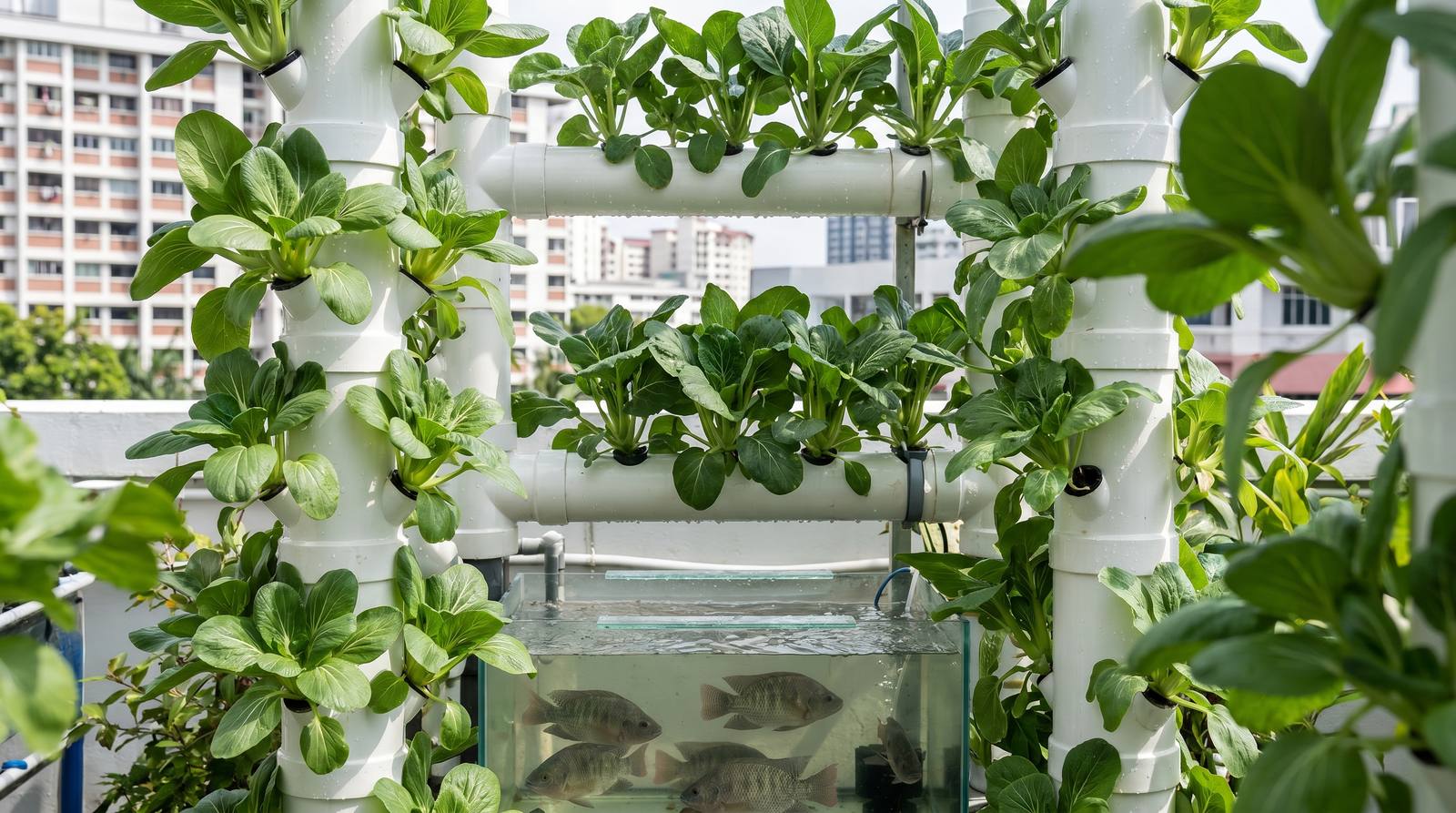
Here's a claim that sounds too good to be true: a tank of fish can feed a wall of fresh vegetables, and do most of the fertilising for you. No soil. No digging. Up to 90% less water than a garden bed. It isn't a trick - it's aquaponics, and once you understand the one simple loop at its heart, the whole thing suddenly makes perfect sense. This is the beginner's guide we wish we'd had when we started - written from years of running a working aquaponics farm in the middle of Singapore.
What is aquaponics, in one sentence?
Aquaponics is a way of growing plants and fish together in one connected system, where the fish fertilise the plants and the plants clean the water for the fish. That's it. Everything else in this guide is just a closer look at how that single sentence actually works - and why it's one of the most water-efficient ways to grow food ever invented.
The word itself is a clue: aqua (water, for the fish) plus ponics (from hydroponics, growing plants in water). Put them together and you get a tiny, self-feeding ecosystem - a pond and a garden that look after each other.
How aquaponics works, step by step: the nitrogen cycle
If aquaponics has a "secret," this is it - and it's the same natural process that keeps every pond, river and lake alive. Here is exactly how aquaponics works, step by step. Follow the water round the loop and you'll never forget it:
- 1. The fish eat, and the fish make waste. Just like any animal, fish produce waste - mostly a chemical called ammonia. In a sealed tank, ammonia builds up and eventually becomes toxic. In nature, something always comes along to clean it. In aquaponics, we let that "something" do our fertilising.
- 2. Invisible bacteria turn waste into plant food. On every wet surface in the system, colonies of beneficial bacteria quietly get to work. They convert the toxic ammonia first into nitrites, then into nitrates - and nitrate is exactly the nitrogen fertiliser that plants love. (On our farm, compost worms help break things down too.) You can't see this step happening, but it is the beating heart of the whole system.
- 3. The plants drink up the fertiliser. The nitrate-rich water is pumped past the plant roots. The roots absorb the nutrients and grow - and in doing so, they strip those same nutrients out of the water. The plants are, in effect, a living water filter.
- 4. The clean water returns to the fish. Now filtered and safe, the water flows back into the fish tank. The fish are happy, the cycle begins again - and it repeats, day after day, for as long as you keep feeding the fish.
Feed the fish. The fish feed the bacteria. The bacteria feed the plants. The plants clean the water for the fish. It's a circle with no loose ends - which is why, once it's balanced, an aquaponics system practically runs itself.
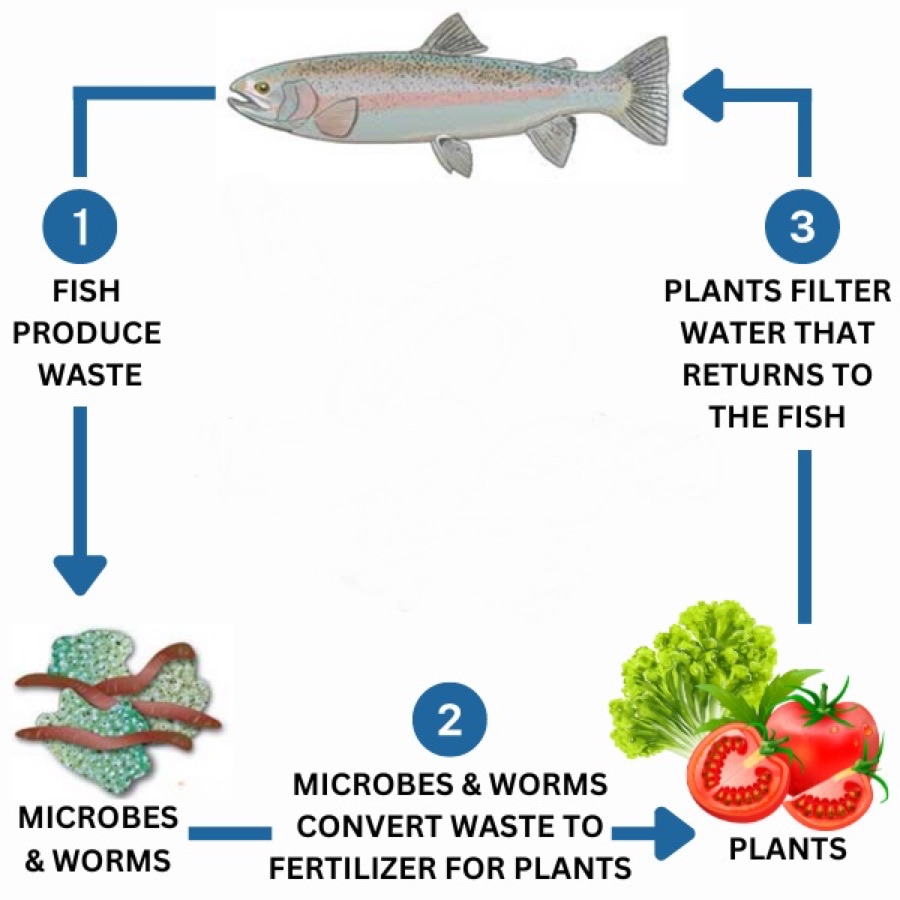
The simplest way to remember it: in a normal garden you feed the plants. In aquaponics, you feed the fish - and the fish feed the plants.
The three living partners
An aquaponics system is really a team of three, each doing a job the others can't:
- The fish are the fuel. Common choices are tilapia (hardy and fast-growing) or ornamental fish if you're not eating them. In Singapore, plenty of home growers keep hardy fish simply to power the loop.
- The bacteria are the engine - the invisible workforce that turns waste into food. You never add them from a shop; they arrive on their own and multiply. Your only job is patience while their numbers build (more on that below).
- The plants are the harvest - and the filter. Leafy greens are the star performers: kailan, xiao bai cai, bok choy, lettuce, kangkong, and herbs all thrive.
Get the balance between these three right, and you have a system that produces food almost for free. That balance is the real skill of aquaponics - and it's exactly what we teach.
"Cycling": the one bit of patience it asks of you
Here's the honest part most beginner guides skip. When you first set up a system, those all-important bacteria aren't there yet - they need a few weeks to establish and multiply before the loop truly hums. This start-up period is called cycling, and it usually takes around three to six weeks.
During cycling you're essentially growing an invisible bacterial colony. It's not hard, but it can't be rushed - a little like waiting for bread dough to prove. The good news: you only do it once. After a system is cycled and stable, it stays that way for years, and looking after it is relaxing. This is also why buying a system that's already cycled, or starting from pre-cycled media, saves beginners the anxious waiting.
Does aquaponics really need zero chemicals?
Nearly - and this is where we'll be straight with you, because honesty is how you learn to grow well. The fish provide the nitrogen, which is the big one plants need most, so you buy far less bottled fertiliser than a hydroponic grower does. But fish waste alone can run a little short on a few specific minerals. Iron is the one every aquaponics system runs short of, so we top it up in small, targeted amounts to keep the leaves a deep, healthy green. And because the bacteria doing all that converting make the water drift steadily acidic, we add carbonates to bring the pH back up into the range where roots can actually take nutrients in. Any grower who tells you a tank of fish needs nothing added at all has not run one for very long.
So the fair way to put it is this: aquaponics does the heavy lifting of fertilising for free, with far less waste and far fewer inputs than other methods - not by magic, but by putting nature's own recycling system to work in your backyard.
Why it uses so little water and land
This is the part that makes aquaponics matter far beyond a fun hobby. Because the same water circulates round and round - only topped up for what the plants drink and what evaporates - an aquaponics system uses up to 90% less water than growing the same crops in soil. Nothing drains away and nothing is thrown out.
And because the plants don't need soil, they can be stacked. Grow towers climb upward instead of spreading outward, so a small footprint can produce a surprising amount of food - perfect for a land-scarce, high-rise city. A sunny corridor, a balcony, a rooftop or a void deck can all become a working micro-farm.
Aquaponics and Singapore's food story
Singapore imports the vast majority of its food, which is why growing more of it locally has become a national priority. The country's food-resilience target is to produce 20% of our fibre and vegetable needs, and 30% of our protein needs, locally by 2035 - and to do it on very little land. Soil-free, water-thrifty, stackable methods like aquaponics are tailor-made for that challenge: they turn balconies, rooftops and unused corners into productive space. Every household that grows even a little of its own food is a small part of that bigger picture.
The bottom line
Aquaponics is one simple loop: you feed the fish, bacteria turn the fish waste into natural fertiliser, the plants eat it and clean the water, and the water returns to the fish. Give it a few weeks to "cycle," keep the three partners in balance, and you get fresh vegetables and fish from one system - using up to 90% less water and almost no waste. It's easier to run than it looks, and far more rewarding than it sounds.
The best way to understand it? See it running
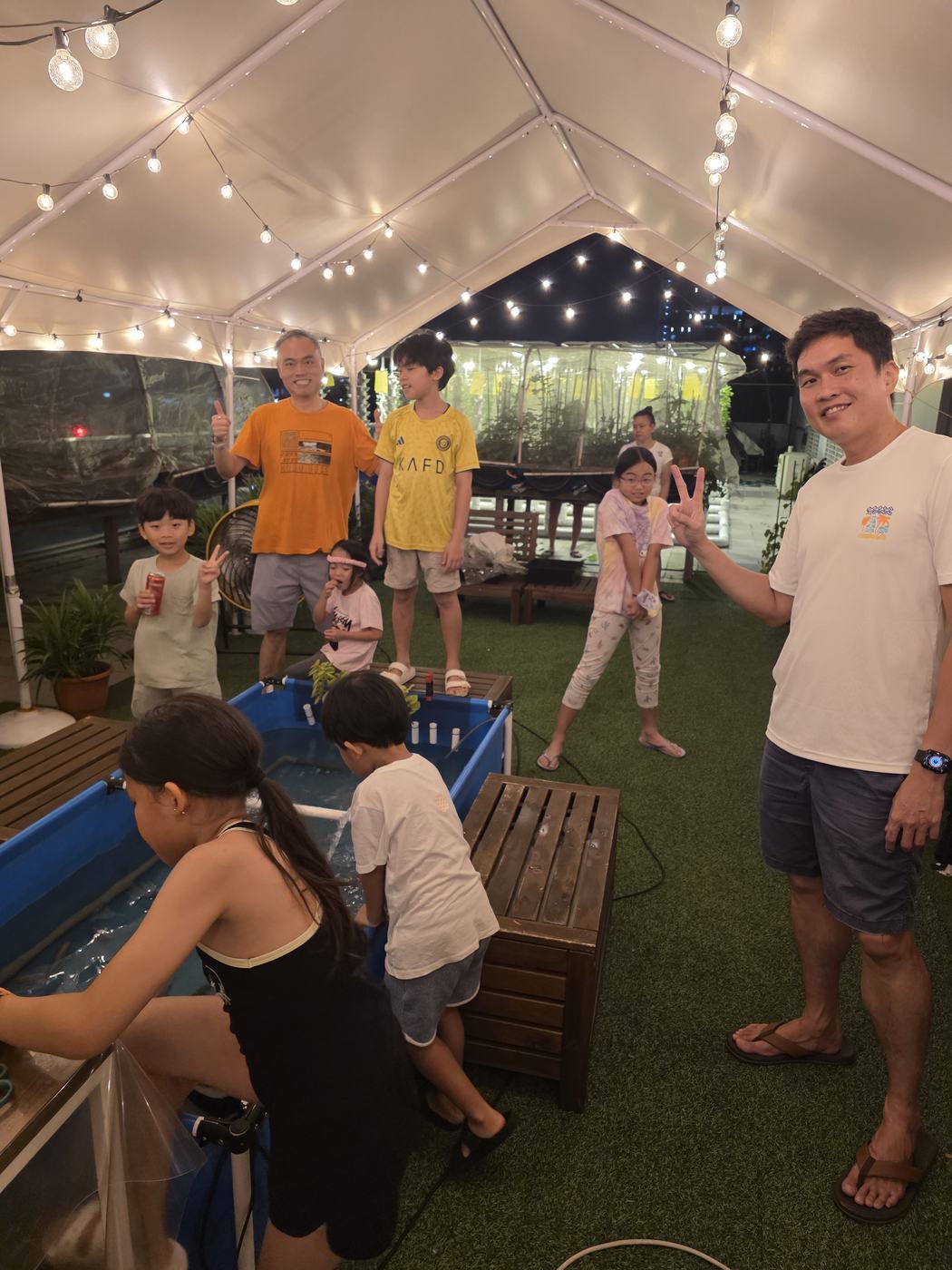
You can read about a nitrogen cycle all day, but nothing lands like watching cloudy fish water feed a wall of crisp green kailan. On our farm tours and experiences you can trace the whole loop with your own eyes - feed the fish, meet the worms, and harvest greens to take home. At our monthly Little Farmers Workshop, children and adults build a take-home vermicompost kit by hand and watch the science click into place. And when you're ready to grow at home, we design and build custom systems sized to your space. New to all of this? Our guide to aquaponics vs hydroponics is a great next read, along with growing food at home in an HDB flat.
Aquaponics FAQs (Singapore beginners)
What does aquaponics mean?
Aquaponics combines aqua (raising fish in water) with ponics (growing plants in water, as in hydroponics). In plain terms, it means growing fish and vegetables together in one system, where the fish naturally fertilise the plants and the plants clean the water for the fish.
How does aquaponics work, step by step?
In four steps: (1) the fish eat and produce waste (ammonia); (2) beneficial bacteria convert that waste into nitrates, a natural plant fertiliser; (3) the plants absorb the nitrates and, in doing so, filter the water; (4) the clean water returns to the fish and the loop repeats. You feed the fish, and the fish feed the plants.
How many fish do you need for aquaponics?
A safe starter rule of thumb is roughly one adult fish per 40-60 litres of tank water, kept on the low side while your system is young and the bacteria are still establishing. As the system matures you can stock more densely. Beginners get into trouble by overstocking too early, so start light - you can always add fish, but you can't un-crowd a tank quickly.
What can you grow in an aquaponics system?
Leafy greens are the star performers and the easiest for beginners: kailan, xiao bai cai, bok choy, lettuce, kangkong, and soft herbs like basil and mint. Once a system is well-established, you can push into fruiting crops such as tomatoes and chillies. On the fish side, tilapia are the classic choice (hardy and fast-growing), though many home growers in Singapore keep ornamental fish purely to run the loop.
Can you do aquaponics without fish?
Not really - if you remove the fish, you remove the natural fertiliser, and what you're left with is essentially hydroponics, where you add bottled nutrients yourself. The fish are the whole point of aquaponics: they're the free, living engine that turns feed into plant food.
Is aquaponics worth it, and is it expensive?
There's an upfront cost to set up a system, but the running cost is low because the fish replace most of your fertiliser bill. For most people the real payoff isn't just cheaper greens - it's the freshness, the near-zero waste, and how engaging a living system is to run, especially with children. If you want to start small and cheap, a compact home unit or a ready-cycled system keeps the first step easy.
Is aquaponics sustainable, and does it really save water?
Yes on both counts. Because the same water recirculates, an aquaponics system uses up to 90% less water than growing the same crops in soil, and its closed loop produces very little waste - no fertiliser run-off, nothing drained away. Grown vertically, it also produces a lot of food from a small footprint, which is exactly why it suits a land-scarce city like Singapore.
What's the difference between aquaponics and hydroponics?
Both grow plants without soil. In hydroponics you add man-made liquid nutrients to the water yourself; in aquaponics, fish provide most of those nutrients naturally. We wrote a full plain-English comparison in Aquaponics vs Hydroponics.
Where can I see or learn aquaponics in Singapore?
Right here. Two Doctors Aquaponics is a working aquaponics farm at 2 Kallang Avenue. You can book an aquaponics farm tour to see the whole loop in action, join a hands-on Little Farmers Workshop for kids or adults, or have us build a custom aquaponics system for your home, school or office. Message us on WhatsApp and we'll point you to the right starting point.